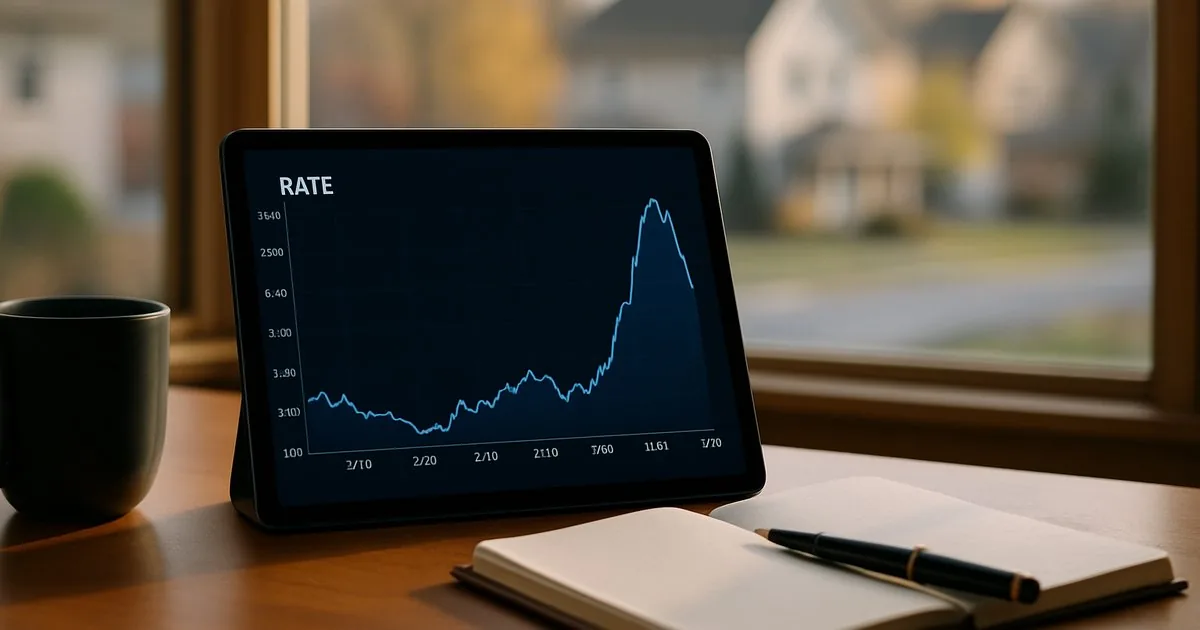
It's the question I get more than any other right now. "Should I wait for rates to drop?" Or the flip side: "Do you think rates will come down this year?"
I'm going to give you my honest take, and I'll tell you upfront that I don't predict rates, and you should be skeptical of anyone who does. But I can give you a framework for thinking about this that actually helps you make a decision.
What the Federal Reserve's April Decision Says (and Why Forecasts Keep Missing) (and Why It's Hard to Know)
Most major forecasters going into 2026 were projecting rates to gradually ease, but "gradually" is doing a lot of work in that sentence. We're talking potentially moving from the upper 6s into the lower 6s over the course of the year, not a sudden drop back to the 3s and 4s we saw in 2020 and 2021.
The problem is that rates are tied to inflation data, the Fed's decisions, and economic conditions that nobody can predict with certainty. Forecasters who said rates would be at 5.5% by now were wrong. That doesn't mean they'll be wrong again, but it means you should plan around what rates are today, not what they might be in six months.
"I've been doing this for 20+ years. I've never seen anyone time the market perfectly. What I have seen is buyers who waited for the perfect rate and missed the perfect house (a pattern that compounds with the deals that fall apart when timing finally works)."
The Real Math on Waiting
Here's what waiting actually costs. Say you're looking at a $350,000 home today at 7%. Your principal and interest payment is about $2,329/month. If rates drop to 6.5% six months from now, that payment drops to about $2,212, a savings of $117/month.
But here's what else happens in six months. Home prices in Oakland and Macomb County have historically continued to appreciate (see the 12-month picture in Rochester, Chippewa Valley, and Royal Oak). If that $350K home is worth $360K six months from now, you've paid $10,000 more for the house. Your rate savings of $117/month takes over 7 years to break even on that price increase. And that's assuming rates actually drop on your timeline.
Meanwhile, if rates do drop, you can refinance. You can always refinance into a lower rate later. You cannot go back in time and buy a house at today's price.
What I Actually Tell My Buyers
I tell them: buy when you're ready, buy what you can afford, and structure your loan so you can refinance cleanly if rates improve, and structure the offer itself so you actually win the right house. Don't buy more house than you can handle at today's rate hoping that a refinance will bail you out. That's too much risk. But if you've found the right house at a payment that works for your budget, waiting for a rate drop that may or may not materialize is a gamble, not a strategy.
The best time to buy is when you're financially ready and you've found a home that makes sense for your life. That's it.
Want to Run Your Numbers?
I can show you exactly what different rate scenarios look like on the specific homes you're considering. Today's rate, what a refinance looks like at 6%, at 5.5%, and what the break-even math is. It takes about 15 minutes and it'll give you a much clearer picture than any rate prediction will.
Frequently asked questions
Will mortgage rates go down in 2026?
Forecasters going into 2026 generally projected gradual easing from the upper 6s into the lower 6s over the year, not a return to the 3 to 4% range. Actual movement has been slower than expected, and the April Fed hold reinforced that pattern.
Should I wait for rates to drop before buying?
For most Michigan buyers, no. Home price appreciation typically exceeds rate-driven payment savings. On a $350,000 home, a half-point rate drop saves about $117 per month, but a 3% price increase over the same period adds $10,000 to the purchase. Rate savings take seven plus years to recover that.
Can I refinance to a lower rate later if rates drop?
Yes. Refinancing is always available if rates improve enough to justify the closing costs. The math typically works once rates drop 0.75 to 1.0 percentage points below your current rate, depending on loan balance and how long you'll stay in the home.
How accurate are mortgage rate predictions?
Not very. Rates depend on inflation data, Fed decisions, and global economic conditions that are hard to predict reliably. Forecasters who said rates would be at 5.5% by now were wrong. Plan around today's rates, not what someone thinks they will be.
What rate should I expect on a Michigan mortgage in 2026?
Conventional 30-year fixed rates have generally been in the upper 6s to low 7s, depending on credit score, down payment, loan size, and lender. Get a same-day quote from a Michigan-licensed lender for your specific scenario.
Why this matters
For homeowners: if you're sitting on a higher-rate loan from 2023 or 2024, set a target refi rate based on your loan size, not on a headline. A 50-basis-point drop matters a lot more on a $400K balance than a $150K balance. Know your actual break-even before you watch the news.
For home buyers: price appreciation costs you more than you save by waiting. Run the math on the specific house you want at today's rate versus a hypothetical 6% in 12 months with a 3% price bump. Most of the time the math says move now and refi later.
For home sellers: hesitant buyers are paralyzed by rate predictions. The fix is showing them the math, not waiting them out. A listing that's been sitting may benefit from a financing concession (rate buydown contribution) more than another price drop.
For real estate agents: "let's wait for rates" is the most expensive advice in real estate right now. Buyers who waited 2024 to 2025 paid 8 to 12% more for the same house. Have a lender on speed dial who can run the actual break-even math in 15 minutes so the conversation moves from feelings to numbers.
Want me to run the actual math for your house, your rate, your refi assumptions? Reach out to Tommy.
Let's run the numbers for your situation.
No pressure. Just clarity on what the math actually looks like.
📞 Call Tommy at (586) 315-4507